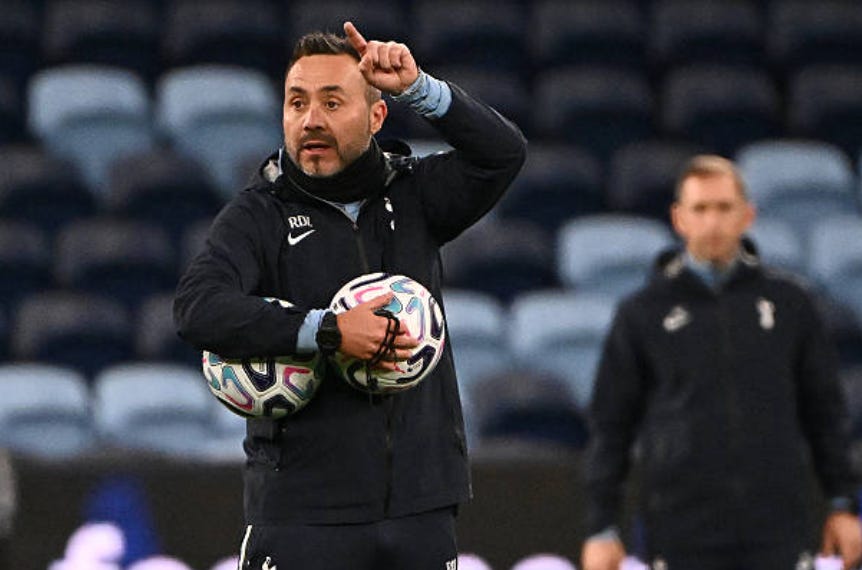
Control Over Chance: De Zerbi throws proper shade on Thomas Frank’s 'winning the second ball' tactics
Roberto De Zerbi’s approach to football is rooted in control, quality, and deliberate construction rather than chance.
A concise video clip circulating among fans captures the essence of his thinking with characteristic directness: launching the ball long in the hope of winning the second ball is, in his words, “a bet.” And De Zerbi does not like betting.
De Zerbi says that kicking the ball long and trying to win the second ball is a bet.
“And since I don’t like betting… I would rather train my team to play out from the back when it is possible… And since I believe more in working than in betting, I do this. Since my teams have always had quality players… I would rather have them receiving the ball on their feet than on their teeth.”
At Brighton, this produced some of the Premier League’s most distinctive and effective possession play: patient circulation near their own goal, baiting the press, then accelerating through the thirds.
The same principles travelled with him. Even in high-stakes moments, he has resisted abandoning the idea, arguing that changing core philosophy under pressure undermines the work done on the training ground.
Organisation with and without the ball matters, yet the starting point remains the conviction that controlled possession is more reliable than contested second balls.
De Zerbi is about conviction, not gambling
In an era when many sides still default to direct play or transitional chaos, De Zerbi’s insistence on building from the back remains a clear statement of values. The clip’s simple metaphor—“I don’t like betting”—distils years of coaching: trust the process, trust the players’ quality, and refuse to leave the outcome to a 50/50 ball in the air. That conviction continues to define how his teams try to play.
There is also a human dimension. De Zerbi wants players to enjoy the game and feel like protagonists. Keeping the ball, waiting for pressure, and solving problems collectively is presented as both more effective and more fulfilling than relying on aerial duels and hope. “Falling in love with the ball” and showing the courage to play out under pressure form part of the mentality he tries to instil.
Critics sometimes call the style high-risk, and mistakes in the build-up do occur. De Zerbi accepts the trade-off. For him, the alternative, repeatedly conceding possession high up the pitch in the hope of winning it back, is the greater gamble.
By prioritising preparation, technical security, and positional structure, he aims to tilt the odds in his team’s favour through work rather than chance.


If he still thinks his system works then we are in for some horror stories. This is now ancient football history and the fans wont accept it when the mistakes happen and we give away silly goals. More goals conceded than scored from this method and with the fans very close to the pitch the pressure on the players will be too much. Why hasnt he moved on.?